
Rental Property Due-Diligence Checklist Before Making an Offer
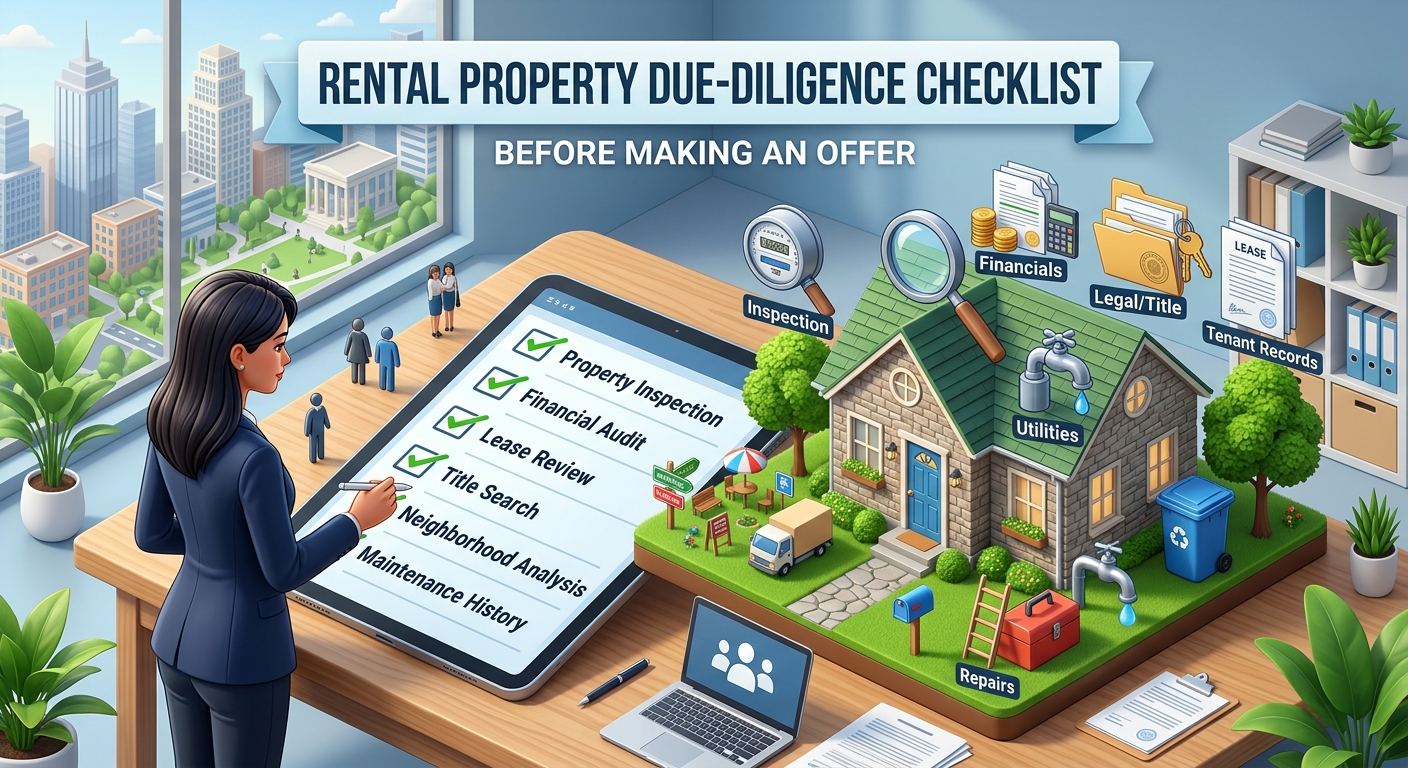
Due diligence begins before the offer and continues until closing. A checklist is valuable because it prevents a persuasive listing, a strong first spreadsheet, or a rushed deadline from hiding the basic facts that make an investment durable or fragile.
Use this as a screening framework
Why this matters now
The best use of a checklist is not to create paperwork. It is to assign an owner, a source, and a deadline to every fact that could change your offer price, financing, rehab scope, rent plan, or exit strategy.
The goal is not to predict one perfect outcome. It is to identify which assumption would hurt the deal first, make that assumption visible, and decide whether the remaining margin is worth the risk.
The framework at a glance
| Area | Verify | Document |
|---|---|---|
| Property | Layout, permits, condition, systems, flood / hazard context | Inspection questions, photos, contractor notes |
| Income | Current lease, market rent, concessions, turnover risk | Rent comps and lease evidence |
| Expenses | Tax, insurance, utilities, HOA, maintenance history | Bills, seller documents, local quotes |
| Financing | Rate, fees, reserves, appraisal, lender conditions | Written loan estimate and timing |
| Value / exit | Comps, ARV assumptions, resale liquidity, refinance path | Comp notes and downside case |
A table is only useful when every input has a source or an explicitly conservative assumption. Label estimates as estimates; do not quietly turn a hope into a fixed number.
A practical walkthrough
Treat each unknown as a potential price adjustment, contingency, or reason to walk away. For example, a roof near end of life is not only a repair line; it can affect insurance, financing, scheduling, reserves, and the credibility of a resale or refinance value.
- Create a report and save the initial assumptions before new information changes them.
- Collect primary documents: lease, tax bill, insurance quote, utility history, disclosures, and inspection results.
- Verify rent with multiple relevant sources and distinguish current rent from market rent.
- Review comparable properties with an inclusion/exclusion note for each meaningful outlier.
- Run the final financing terms and a downside case before removing contingencies.
- Write the holding and exit plan in plain language, including what would make you change it.
After each step, write down what would change your mind. That turns underwriting into a repeatable decision process instead of a spreadsheet that confirms a property you already want to buy.
Common mistakes to avoid
- Letting a broad market narrative replace address-level verification.
- Assuming a renovation is permitted, financeable, or rentable without checking.
- Skipping a reserve plan because the base-case cash flow is positive.
- Treating a public report link as permission for others to edit a deal; owner actions remain protected.
Do not optimize one metric in isolation
Turn the lesson into an underwriting habit
Run the base case first, then test a downside case before you become attached to the property. For a rental, that usually means pressure-testing rent, vacancy, maintenance, financing, taxes, insurance, and upfront repairs.
Use the Dwelize rental property calculator for a transparent first pass, then analyze a real address when you need a report workspace, an editable valuation workflow, comparable properties, and sharing.
Related reading
- Read Can I share a report? before sending a deal to a partner.
- Use How it works to understand the report workflow.
- Review the sample report before building your first complete analysis.
For definitions of the underlying metrics, see cap rate, ARV, cash-on-cash return, GRM, and the underwriting FAQ.