
Rental Deal Stress Test: 5 Assumptions to Break Before You Buy
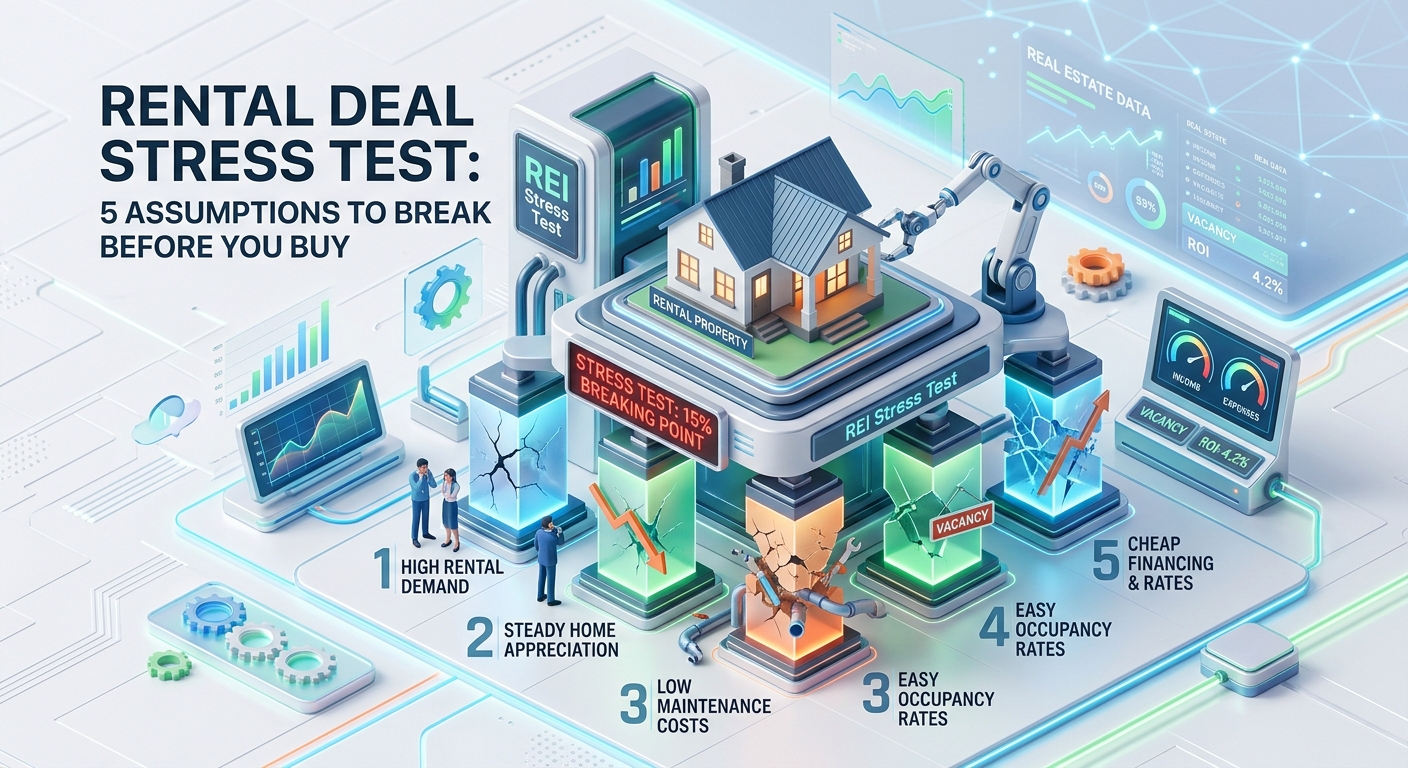
A rental deal that works only with perfect rent, no repairs, and the rate you hoped to get is not a resilient deal. A rental property stress test deliberately changes the assumptions most likely to move after you make an offer.
Use this as a screening framework
Why this matters now
When financing and operating costs take a larger share of rent, a small change can erase a thin margin. Current investor education repeatedly focuses on conservative underwriting rather than relying on a single rule of thumb; the question is not whether a property produces cash flow in one spreadsheet cell, but whether it can absorb a bad month.
The goal is not to predict one perfect outcome. It is to identify which assumption would hurt the deal first, make that assumption visible, and decide whether the remaining margin is worth the risk.
The framework at a glance
| Assumption | Base case | Downside test | Question to answer |
|---|---|---|---|
| Interest rate | Your quoted rate | +1 percentage point | Does debt service erase cash flow? |
| Monthly rent | Verified comp-supported rent | -5% to -10% | How much rent cushion exists? |
| Vacancy | Local operating assumption | +3 to +5 points | Can reserves cover longer turnover? |
| Maintenance / CapEx | Annual reserve | Higher repair year | Does one major repair break the plan? |
| Taxes and insurance | Current estimate | Higher renewal | Is the operating budget still credible? |
A table is only useful when every input has a source or an explicitly conservative assumption. Label estimates as estimates; do not quietly turn a hope into a fixed number.
A practical walkthrough
Imagine a property with $300 per month of projected cash flow. That is not a verdict; it is the beginning of the work. Re-run the case with rent 5% lower, vacancy 4 points higher, a rate one point higher, and an added repair reserve. If the result turns negative immediately, the original margin was too narrow to call durable.
- Start with current, documented price, rent, tax, insurance, and financing inputs—not a future wish.
- Change one assumption at a time so you can see which lever matters most.
- Run a combined downside case after individual tests; real life rarely changes one cost at a time.
- Record the break-even rent and compare it with credible local rent evidence.
- Decide in advance what minimum margin, reserve, and return justify an offer.
After each step, write down what would change your mind. That turns underwriting into a repeatable decision process instead of a spreadsheet that confirms a property you already want to buy.
Common mistakes to avoid
- Using an average mortgage rate instead of the rate and fees available to you.
- Assuming property taxes and insurance remain flat after purchase or renewal.
- Treating a seller’s rent estimate as market rent without checking comparable listings.
- Calling a repair budget a contingency when it has already been spent in the base case.
Do not optimize one metric in isolation
Turn the lesson into an underwriting habit
Run the base case first, then test a downside case before you become attached to the property. For a rental, that usually means pressure-testing rent, vacancy, maintenance, financing, taxes, insurance, and upfront repairs.
Use the Dwelize rental property calculator for a transparent first pass, then analyze a real address when you need a report workspace, an editable valuation workflow, comparable properties, and sharing.
Related reading
- How to Analyze a Rental Property Step by Step explains why real inputs matter more than optimistic placeholders.
- Read What metrics does a report include? before choosing a single pass/fail metric.
- Use Break-even rent alongside cash flow to see your cushion.
For definitions of the underlying metrics, see cap rate, ARV, cash-on-cash return, GRM, and the underwriting FAQ.