
How to Review Comparable Sales Without Cherry-Picking
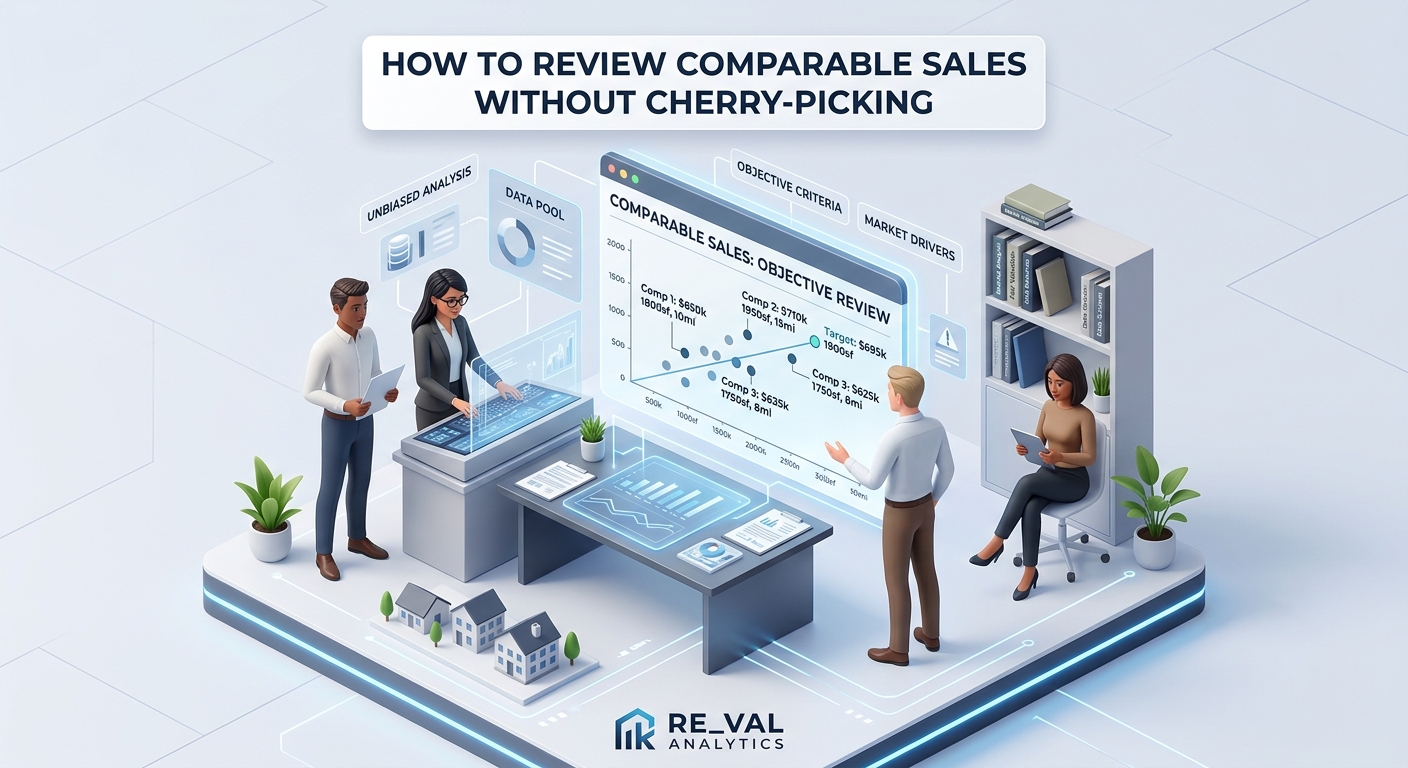
Comparable sales are persuasive because they look objective. They become dangerous when an investor starts with a desired ARV and selects only the sales that support it. A useful comp review makes the inclusion and exclusion logic visible.
Use this as a screening framework
Why this matters now
When a valuation drives an offer price, repair plan, or refinance story, a few weak comps can move the conclusion materially. The right response is not to pretend a comp set is perfect; it is to understand how confident you should be in it.
The goal is not to predict one perfect outcome. It is to identify which assumption would hurt the deal first, make that assumption visible, and decide whether the remaining margin is worth the risk.
The framework at a glance
| Review factor | Ask this question | Red flag |
|---|---|---|
| Location | Is it truly a competing micro-market? | Crossing a school, highway, or neighborhood boundary without explanation |
| Recency | Does the sale reflect current conditions? | Relying on old sales while calling the result current |
| Physical similarity | How different are size, beds, baths, and lot? | Using a superior property without a condition adjustment |
| Condition | Was the comp renovated, distressed, or turnkey? | Assuming photos prove comparable quality |
| Outliers | Why is this sale materially higher or lower? | Excluding it only because it weakens the target ARV |
A table is only useful when every input has a source or an explicitly conservative assumption. Label estimates as estimates; do not quietly turn a hope into a fixed number.
A practical walkthrough
Suppose three nearby homes have similar square footage, but one is fully renovated and one backs onto a busy road. Do not average them blindly. State what each one contributes, what it does not prove, and whether the subject property’s renovation scope actually closes the condition gap.
- Begin with the subject property’s likely post-repair condition, not only its current condition.
- Review each comp for location, recency, size, layout, condition, and sale context.
- Keep a short written reason for including or excluding every borderline comp.
- Look at the spread, not just the average; a wide spread should lower confidence.
- Separate the original AI estimate from a comp-derived conclusion instead of overwriting the story.
After each step, write down what would change your mind. That turns underwriting into a repeatable decision process instead of a spreadsheet that confirms a property you already want to buy.
Common mistakes to avoid
- Using active listings as though they were closed sales.
- Calling a comp “nearby” without considering a meaningful boundary.
- Ignoring photos, days on market, or sale date when they contradict the target value.
- Treating a confidence badge as proof rather than a prompt to inspect the selected set.
Do not optimize one metric in isolation
Turn the lesson into an underwriting habit
Run the base case first, then test a downside case before you become attached to the property. For a rental, that usually means pressure-testing rent, vacancy, maintenance, financing, taxes, insurance, and upfront repairs.
Use the Dwelize rental property calculator for a transparent first pass, then analyze a real address when you need a report workspace, an editable valuation workflow, comparable properties, and sharing.
Related reading
- How do comps change ARV? explains the Dwelize valuation path.
- Read Can I choose which comps to use? before loading comparable properties.
- Review the ARV guide for the role of value after repairs.
For definitions of the underlying metrics, see cap rate, ARV, cash-on-cash return, GRM, and the underwriting FAQ.