
Rental Property Expense Budget: What to Include Before You Make an Offer
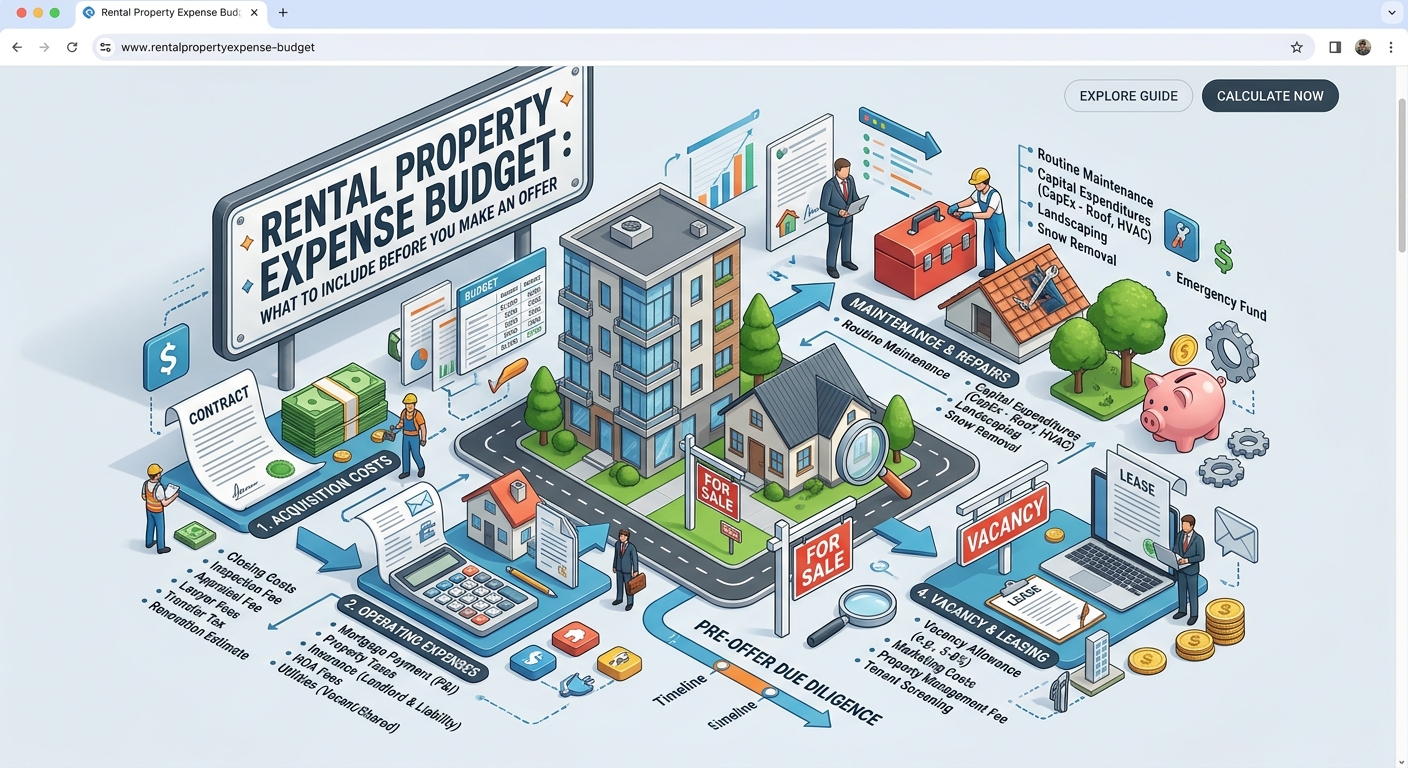
The easiest way to make a rental look attractive is to omit expenses. A complete rental property expense budget separates recurring operating costs, irregular capital costs, financing, and one-time acquisition items so each decision is based on the same picture.
Use this as a screening framework
Why this matters now
Taxes, insurance, utilities, maintenance, and materials can change independently of rent. A budget that only includes principal and interest is not conservative simply because the mortgage number is exact.
The goal is not to predict one perfect outcome. It is to identify which assumption would hurt the deal first, make that assumption visible, and decide whether the remaining margin is worth the risk.
The framework at a glance
| Expense group | Examples | How to treat it |
|---|---|---|
| Recurring operations | Tax, insurance, HOA, utilities, management | Model as current or locally verified annual/monthly costs |
| Income loss | Vacancy, turnover, concessions, bad debt | Use a stated percentage or reserve |
| Maintenance | Small repairs and service calls | Use a recurring reserve, then validate with property condition |
| CapEx | Roof, HVAC, plumbing, exterior | Separate longer-life replacements from everyday maintenance |
| Acquisition / project | Closing, initial repairs, inspections | Treat as cash invested, not normal monthly expenses |
A table is only useful when every input has a source or an explicitly conservative assumption. Label estimates as estimates; do not quietly turn a hope into a fixed number.
A practical walkthrough
A property may show positive cash flow after principal and interest yet become negative after taxes, insurance, vacancy, and maintenance. That does not mean the property is automatically bad; it means the investor has finally identified the assumptions that need evidence before offering a price.
- Start with tax and insurance figures tied to the actual address whenever available.
- Write down who pays each utility and whether the arrangement is likely to change.
- Use separate lines for vacancy, routine maintenance, and longer-life capital items.
- Include property management even if you plan to self-manage; it shows the cost of replacing your time.
- Put inspection discoveries and immediate renovations into the initial cash requirement.
After each step, write down what would change your mind. That turns underwriting into a repeatable decision process instead of a spreadsheet that confirms a property you already want to buy.
Common mistakes to avoid
- Counting a roof reserve as zero because the roof looks acceptable in listing photos.
- Double-counting repairs in both maintenance and a one-time rehab budget.
- Assuming a current owner’s tax bill will equal the post-sale assessment.
- Comparing two properties with different utility responsibilities as if rent alone settles the comparison.
Do not optimize one metric in isolation
Turn the lesson into an underwriting habit
Run the base case first, then test a downside case before you become attached to the property. For a rental, that usually means pressure-testing rent, vacancy, maintenance, financing, taxes, insurance, and upfront repairs.
Use the Dwelize rental property calculator for a transparent first pass, then analyze a real address when you need a report workspace, an editable valuation workflow, comparable properties, and sharing.
Related reading
- How the numbers work explains the report metrics affected by expenses.
- Use the rental property calculator to make every line visible.
- Read How to estimate repair costs before setting a renovation assumption.
For definitions of the underlying metrics, see cap rate, ARV, cash-on-cash return, GRM, and the underwriting FAQ.