
Seller Financing for Off-Market Deals: Model the Terms Before You Model the Story
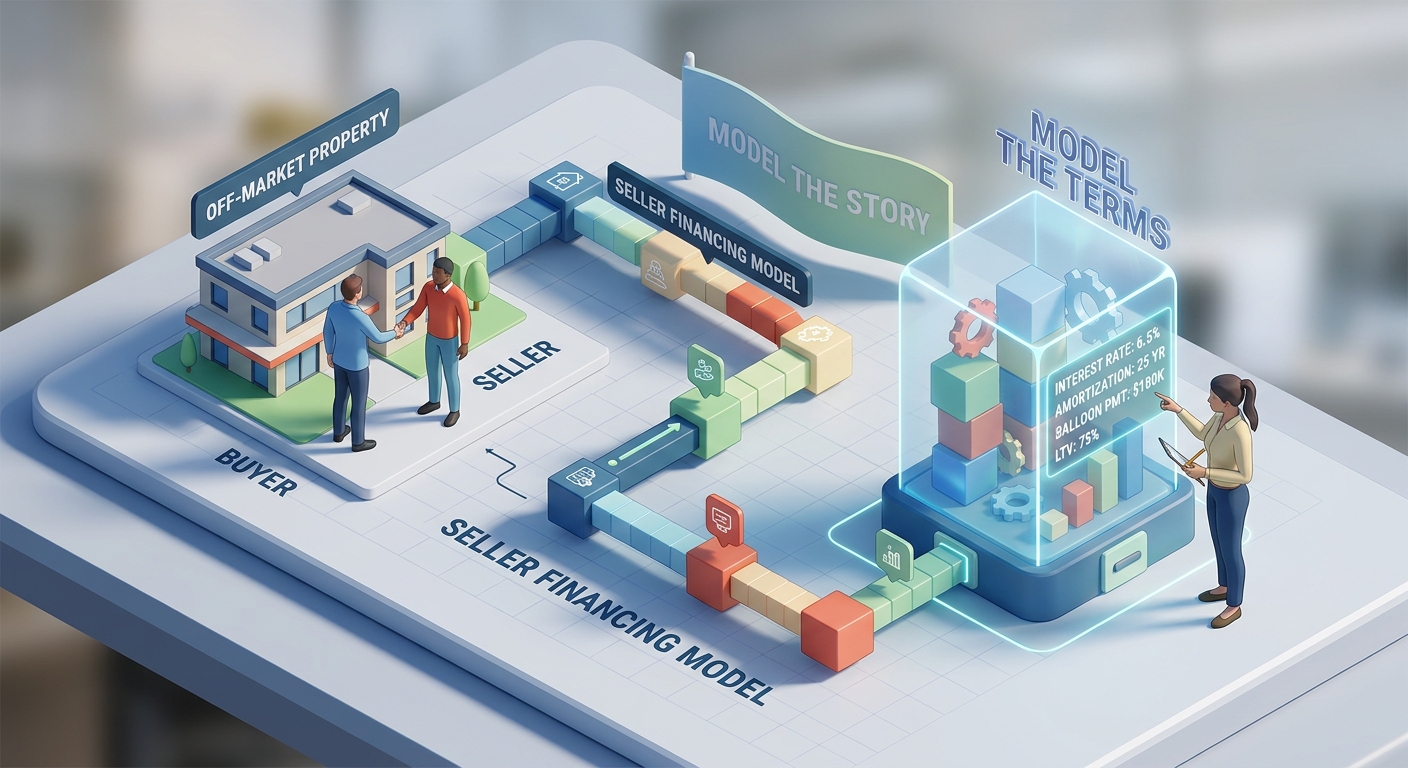
Seller financing can make an off-market conversation more flexible, especially when price, timing, or conventional financing does not fit both parties. It is not automatically cheap financing. The payment, rate, amortization, balloon date, down payment, fees, title structure, servicing, default terms, and exit plan all belong in the same model as the property itself.
Off-market does not mean unverified
What “off-market” really means
Off-market usually means the property is not being broadly marketed on a public multiple-listing service at the moment you find it. It does not automatically mean below-market pricing, a motivated seller, a clean title, or a simpler closing. It only changes the acquisition channel. The investor still has to establish why the seller may transact, what the property is worth, and whether the operating case survives a conservative downside test.
That distinction matters because off-market opportunities often arrive with less structured information. A listing may include photographs, taxes, square footage, disclosures, and an asking price; a direct conversation may include only an address and a story. Treat missing data as an item to verify, not as permission to fill the gap with the most favorable assumption.
How to find and qualify the lead
Discuss terms only after confirming that the property fits your buy box. Ask whether the seller values a certain payment, a specific closing date, recurring income, a balloon payoff, or simplicity. Avoid presenting a structure as universally better for the seller. Both parties should have the opportunity to obtain independent legal, tax, and financial advice.
- Put every proposed term in writing before comparing it.
- Calculate payment, balance, and balloon payoff under the exact structure.
- Run a downside case for rent, expenses, value, and refinance availability.
- Obtain independent professional review of documents and applicable requirements.
- Keep adequate reserves rather than using every dollar for a lower payment.
The numbers before the conversation gets expensive
Calculate the actual periodic payment and all cash due at closing. Then model the balloon date as a hard deadline: can the projected rental performance, refinancing path, and value support payoff if market conditions are worse than expected? Include servicing, insurance, taxes, reserves, and any required repairs. A lower initial payment does not remove the need for a viable long-term exit.
| Term | Model question | Risk to test |
|---|---|---|
| Down payment | How much cash is committed now? | Reserve adequacy after closing |
| Interest rate | What is the true payment? | Payment sensitivity and affordability |
| Amortization | How quickly does principal decline? | Balance at refinance |
| Balloon | When must remaining balance be paid? | Refinance / sale feasibility |
| Existing debt | What liens remain? | Due-on-sale and title risk |
Use ranges during the first pass. A low, base, and high repair estimate is more honest than one precise number obtained before an inspection. Do the same for rent, vacancy, insurance, financing, and closing costs. If the deal only works at the most optimistic end of every range, it is not yet an actionable deal.
Do not confuse a discount with a deal
Compare the off-market route with the public market
Conventional financing may offer standardized disclosures and a predictable process, while seller financing can offer tailored timing and terms. Flexibility can introduce complexity: documentation, servicing, enforcement, existing-loan risk, and refinance dependence. Compare the full cash flow and exit obligations, not just the stated interest rate.
A repeatable decision process
Start by recording the source of the lead, the seller’s stated timeline, and the facts you have actually verified. Then create a first-pass Dwelize report using conservative price, rent, and operating assumptions. The report is not a substitute for inspection, title work, professional advice, or a local agent; it gives the conversation a clear numerical baseline.
Next, decide which fact would most change your offer: repair scope, rent, value, title, financing, or timeline. Obtain evidence for that fact before negotiating around a final number. This approach is slower than sending a blind offer, but it prevents an apparent sourcing advantage from becoming an underwriting disadvantage.
Common mistakes
- Comparing interest rates without comparing amortization and balloon balance.
- Assuming a future refinance is guaranteed.
- Failing to verify title, liens, insurance, or existing-loan terms.
- Using informal paperwork for a complex long-term obligation.
“The advantage in off-market acquisitions is not secret access. It is a repeatable process for turning incomplete information into a disciplined decision.”
Next steps and related reading
Build a simple acquisition log: lead source, contact date, property facts, asking price, estimated total cost, verified rent range, key unknown, and next action. Review the log weekly. Over time it shows which channels generate conversations, which generate offers, and which actually generate closings—three very different measures.
For the supporting calculations, use the rental property calculator, then compare cap rate, cash-on-cash return, ARV, and break-even rent. Every number should remain a decision aid, not a promise of performance.