
Off-Market Properties: A Practical Investor’s Guide to Finding Better Leads
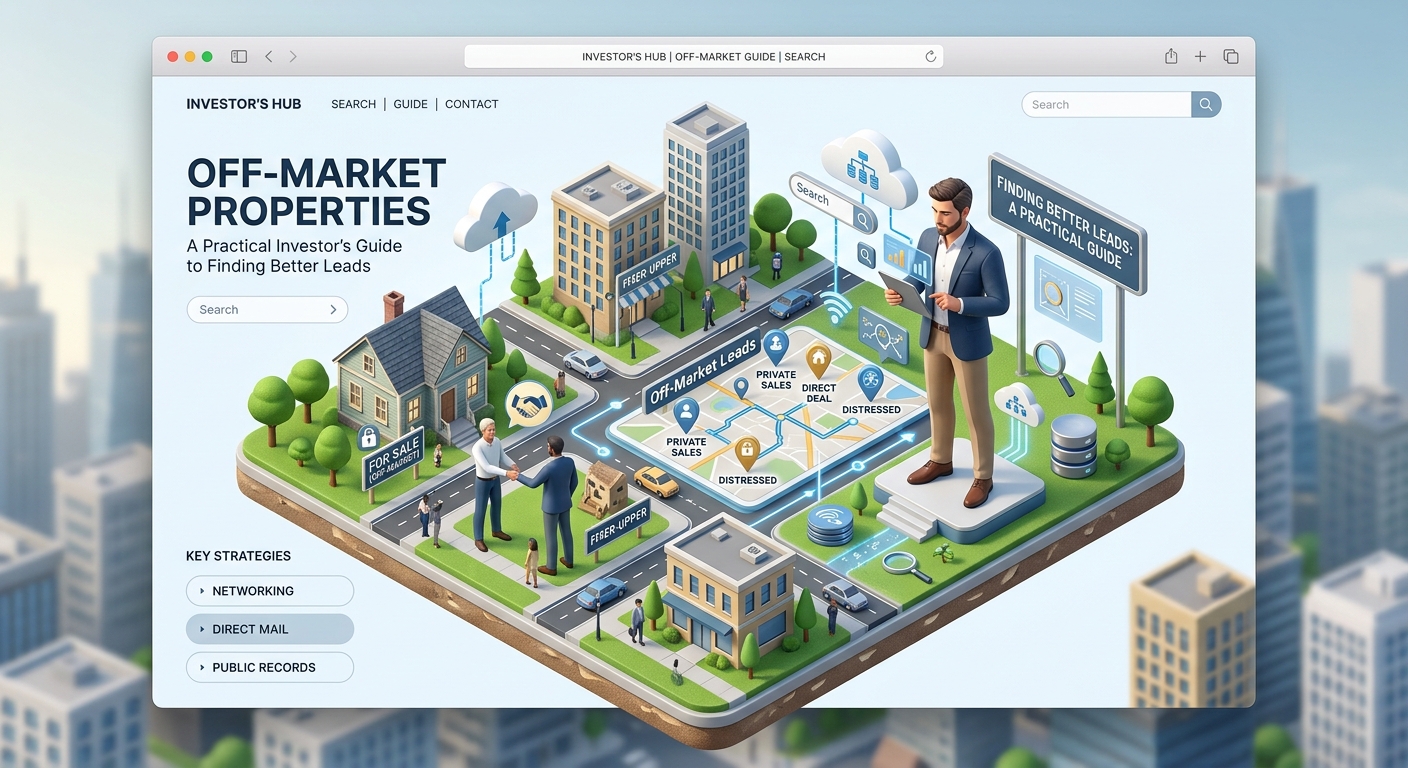
Off-market property investing attracts attention because it promises less competition and more room for a direct conversation. The useful version of that promise is modest: a relationship-based channel can create an earlier look at a potential transaction. The dangerous version is assuming that a private lead must be a bargain. Strong investors use off-market sourcing to create more qualified conversations, then apply the same underwriting discipline they would use for any public listing.
Off-market does not mean unverified
What “off-market” really means
Off-market usually means the property is not being broadly marketed on a public multiple-listing service at the moment you find it. It does not automatically mean below-market pricing, a motivated seller, a clean title, or a simpler closing. It only changes the acquisition channel. The investor still has to establish why the seller may transact, what the property is worth, and whether the operating case survives a conservative downside test.
That distinction matters because off-market opportunities often arrive with less structured information. A listing may include photographs, taxes, square footage, disclosures, and an asking price; a direct conversation may include only an address and a story. Treat missing data as an item to verify, not as permission to fill the gap with the most favorable assumption.
How to find and qualify the lead
Start with channels where a seller, local professional, or owner may have a reason to talk before publicly listing: investor-friendly agents, property managers, attorneys, contractors, wholesalers, neighborhood outreach, and your own network. Build a narrow buy box first—location, property type, price range, repair tolerance, rent target, and financing limit—so every source can recognize a relevant lead instead of sending every available address.
- Write a one-page buy box before contacting sources.
- Ask every source for the seller’s timeline, price expectation, condition, occupancy, and reason for selling.
- Log each lead in the same format so channels can be compared fairly.
- Run a conservative first pass before scheduling a detailed visit.
- Advance only when the key unknown has a clear way to be verified.
The numbers before the conversation gets expensive
Your first calculation should be total acquisition cost: purchase price plus closing costs, immediate repairs, financing costs, and an appropriate contingency. Estimate rent from credible local evidence, include vacancy and operating costs, and compare the resulting cash flow and break-even rent against a downside case. A private deal deserves more documentation, not fewer calculations.
| Screen | First-pass question | Evidence to collect |
|---|---|---|
| Motivation | Why might the owner sell now? | Stated timeline, condition, ownership context |
| Price | What is the total acquisition cost? | Ask, repairs, closing and financing estimates |
| Rent | What is a conservative monthly range? | Relevant rent comps and property condition |
| Value | What supports the purchase or ARV case? | Recent comparable sales and condition notes |
| Risk | What could change the offer? | Inspection, title, insurance, financing, permits |
Use ranges during the first pass. A low, base, and high repair estimate is more honest than one precise number obtained before an inspection. Do the same for rent, vacancy, insurance, financing, and closing costs. If the deal only works at the most optimistic end of every range, it is not yet an actionable deal.
Do not confuse a discount with a deal
Compare the off-market route with the public market
Public listings offer broader visibility, more comparable information, and often a clearer bidding process. Off-market leads can offer earlier dialogue and terms flexibility, but they may require more work to establish value and condition. Compare both channels by closed deals and verified margins, not by how many addresses they produce.
A repeatable decision process
Start by recording the source of the lead, the seller’s stated timeline, and the facts you have actually verified. Then create a first-pass Dwelize report using conservative price, rent, and operating assumptions. The report is not a substitute for inspection, title work, professional advice, or a local agent; it gives the conversation a clear numerical baseline.
Next, decide which fact would most change your offer: repair scope, rent, value, title, financing, or timeline. Obtain evidence for that fact before negotiating around a final number. This approach is slower than sending a blind offer, but it prevents an apparent sourcing advantage from becoming an underwriting disadvantage.
Common mistakes
- Calling every unlisted property “off-market” even when the owner has no intent to sell.
- Sending offers before understanding condition, occupancy, or title.
- Measuring a channel by leads instead of qualified opportunities and closed outcomes.
- Assuming fewer bidders removes the need to negotiate respectfully and transparently.
“The advantage in off-market acquisitions is not secret access. It is a repeatable process for turning incomplete information into a disciplined decision.”
Next steps and related reading
Build a simple acquisition log: lead source, contact date, property facts, asking price, estimated total cost, verified rent range, key unknown, and next action. Review the log weekly. Over time it shows which channels generate conversations, which generate offers, and which actually generate closings—three very different measures.
- How to Analyze a Rental Property in 20 Minutes
- Rental Property Due-Diligence Checklist
- Can I share a report?
For the supporting calculations, use the rental property calculator, then compare cap rate, cash-on-cash return, ARV, and break-even rent. Every number should remain a decision aid, not a promise of performance.