
Direct Mail for Off-Market Real Estate: Build a Testable Seller Outreach System
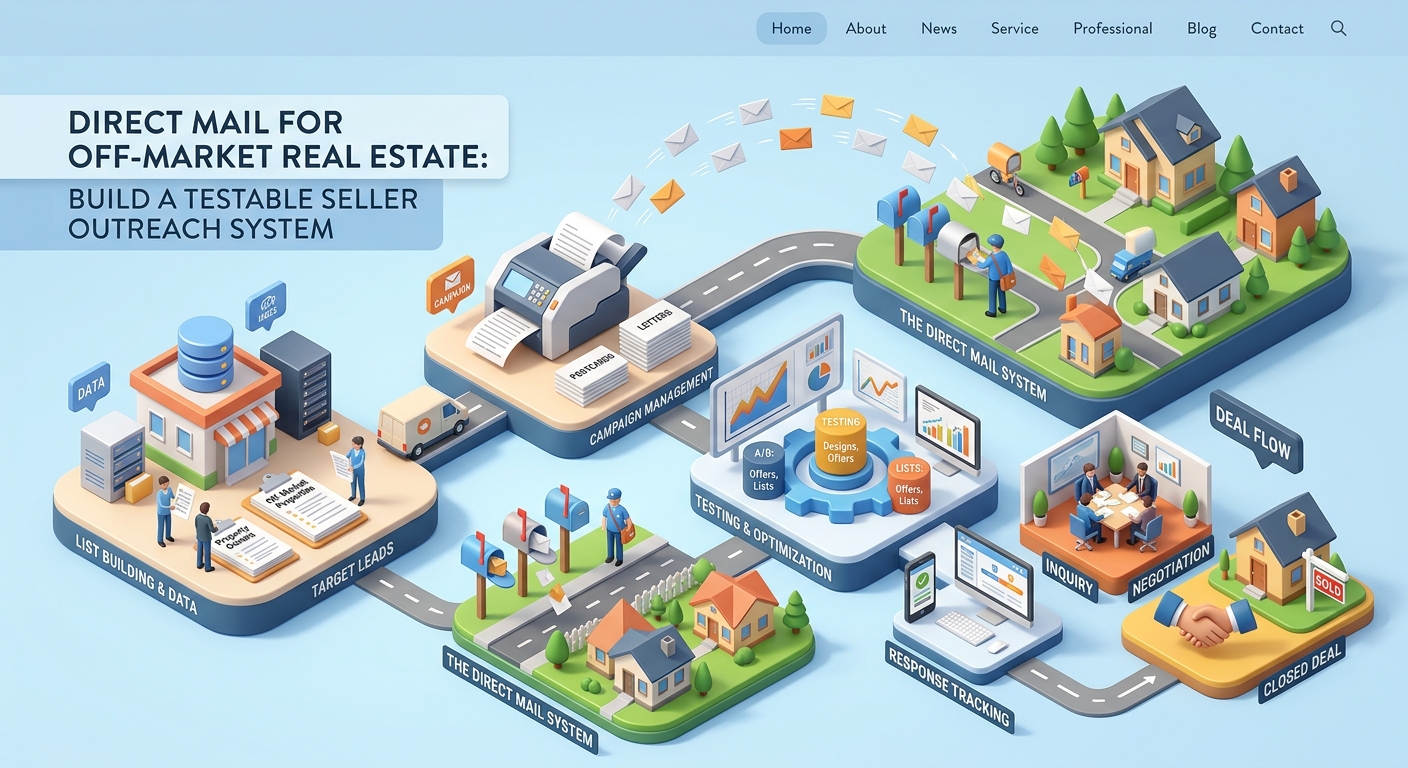
Direct mail is not a magic list or a clever postcard. It is a measurable outreach channel: you select a defined audience, send a respectful message, handle responses professionally, and compare the eventual cost of a qualified conversation or closed deal with your other channels. A small, carefully tracked test is more useful than a large campaign with no follow-up process.
Off-market does not mean unverified
What “off-market” really means
Off-market usually means the property is not being broadly marketed on a public multiple-listing service at the moment you find it. It does not automatically mean below-market pricing, a motivated seller, a clean title, or a simpler closing. It only changes the acquisition channel. The investor still has to establish why the seller may transact, what the property is worth, and whether the operating case survives a conservative downside test.
That distinction matters because off-market opportunities often arrive with less structured information. A listing may include photographs, taxes, square footage, disclosures, and an asking price; a direct conversation may include only an address and a story. Treat missing data as an item to verify, not as permission to fill the gap with the most favorable assumption.
How to find and qualify the lead
Define one reason a homeowner may value a conversation—an inherited property, deferred maintenance, long-distance ownership, an expired listing, or a simple desire for timing flexibility—without assuming distress or making promises. Make the message easy to understand, include a real contact method, and honor requests not to be contacted. Check applicable federal, state, and local rules before sending any campaign.
- Choose one narrow owner segment and one geography for the first test.
- Write a plain-language message that invites a conversation rather than pressure.
- Set up a response log before the first piece is mailed.
- Use the same intake questions for every response.
- Review results after enough time for delivery and follow-up, then change one variable at a time.
The numbers before the conversation gets expensive
Add marketing cost to the acquisition model rather than treating it as free. Track pieces sent, delivered responses, real conversations, appointments, offers, contracts, and closings. Divide channel spend by each stage to understand where quality changes. A campaign that produces cheap calls but no viable properties is not necessarily cheaper than an agent referral that produces fewer, better leads.
| Metric | Formula | Decision use |
|---|---|---|
| Response rate | Responses ÷ pieces sent | Tests message and list relevance |
| Conversation rate | Qualified conversations ÷ responses | Tests lead quality |
| Offer rate | Offers ÷ qualified conversations | Tests buy-box fit |
| Cost per lead | Campaign spend ÷ qualified conversations | Compares channels |
| Cost per closing | Campaign spend ÷ closings | Measures acquisition cost |
Use ranges during the first pass. A low, base, and high repair estimate is more honest than one precise number obtained before an inspection. Do the same for rent, vacancy, insurance, financing, and closing costs. If the deal only works at the most optimistic end of every range, it is not yet an actionable deal.
Do not confuse a discount with a deal
Compare the off-market route with the public market
Mail can scale and can reach owners who are not connected to an investor network, but it requires list quality, operations, and patience. Referrals may cost less in cash but more in time and relationship building. A public listing is immediately visible but may be more competitive. Use a portfolio of channels and measure each by verified economics.
A repeatable decision process
Start by recording the source of the lead, the seller’s stated timeline, and the facts you have actually verified. Then create a first-pass Dwelize report using conservative price, rent, and operating assumptions. The report is not a substitute for inspection, title work, professional advice, or a local agent; it gives the conversation a clear numerical baseline.
Next, decide which fact would most change your offer: repair scope, rent, value, title, financing, or timeline. Obtain evidence for that fact before negotiating around a final number. This approach is slower than sending a blind offer, but it prevents an apparent sourcing advantage from becoming an underwriting disadvantage.
Common mistakes
- Buying a broad list before proving a message and follow-up system.
- Using language that implies urgency, legal consequences, or guaranteed pricing.
- Failing to honor opt-out requests or applicable solicitation rules.
- Counting every inbound call as a qualified lead.
“The advantage in off-market acquisitions is not secret access. It is a repeatable process for turning incomplete information into a disciplined decision.”
Next steps and related reading
Build a simple acquisition log: lead source, contact date, property facts, asking price, estimated total cost, verified rent range, key unknown, and next action. Review the log weekly. Over time it shows which channels generate conversations, which generate offers, and which actually generate closings—three very different measures.
For the supporting calculations, use the rental property calculator, then compare cap rate, cash-on-cash return, ARV, and break-even rent. Every number should remain a decision aid, not a promise of performance.