
Vacant Properties: Off-Market Opportunity or Expensive Unknown?
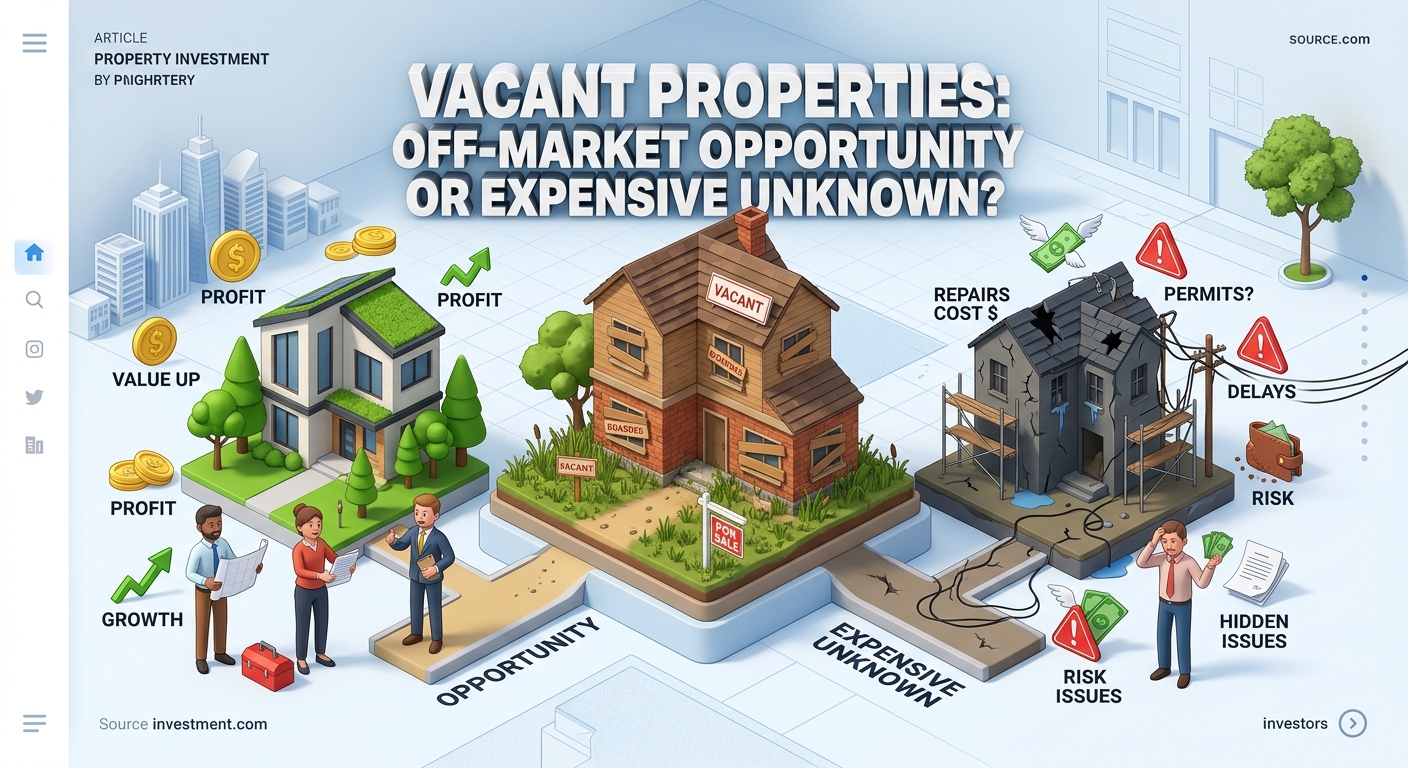
A vacant property can create a real opening for a conversation, but vacancy is a condition to investigate—not an investment thesis. It may result from renovation, a recent move, an inherited property, a failed tenant placement, insurance work, litigation, or a seller who simply is not interested. The investor’s advantage comes from carefully resolving the unknowns that vacancy creates.
Off-market does not mean unverified
What “off-market” really means
Off-market usually means the property is not being broadly marketed on a public multiple-listing service at the moment you find it. It does not automatically mean below-market pricing, a motivated seller, a clean title, or a simpler closing. It only changes the acquisition channel. The investor still has to establish why the seller may transact, what the property is worth, and whether the operating case survives a conservative downside test.
That distinction matters because off-market opportunities often arrive with less structured information. A listing may include photographs, taxes, square footage, disclosures, and an asking price; a direct conversation may include only an address and a story. Treat missing data as an item to verify, not as permission to fill the gap with the most favorable assumption.
How to find and qualify the lead
Begin with ownership and property facts, then use respectful outreach. Do not enter the property or assume it is abandoned. Ask whether the owner is open to a conversation, what work has been completed, how long the property has been vacant, whether utilities are active, and whether there are known insurance, title, permit, or occupancy issues.
- Verify ownership before making contact.
- Ask permission for access and document observations carefully.
- Inspect systems and water-related risk as early as practical.
- Model carrying time to rent-ready condition and first lease.
- Use a title company, insurer, inspector, and appropriate local professionals before committing.
The numbers before the conversation gets expensive
Vacancy changes more than projected rent. It can affect utility costs, carrying costs, insurance, security, condition deterioration, leasing timeline, and repair scope. Model a longer stabilization period than you would for an occupied, performing rental. Include the cost of making the property rent-ready, not just the cost of visible cosmetic repairs.
| Question | Why it matters | Evidence |
|---|---|---|
| How long vacant? | Signals carrying and condition risk | Owner statement, utilities, observation |
| Utilities active? | Affects systems inspection and damage risk | Utility status and inspection |
| Why vacant? | Changes timeline and negotiation context | Owner / manager documentation |
| Rent-ready scope? | Determines stabilization cost | Walkthrough and contractor estimate |
| Insurance / title? | Can delay or prevent closing | Carrier and title review |
Use ranges during the first pass. A low, base, and high repair estimate is more honest than one precise number obtained before an inspection. Do the same for rent, vacancy, insurance, financing, and closing costs. If the deal only works at the most optimistic end of every range, it is not yet an actionable deal.
Do not confuse a discount with a deal
Compare the off-market route with the public market
An occupied rental gives you a lease, payment history, and condition evidence from current use, but it can also include tenant and turnover constraints. A vacant property offers access and a clean start, but less income evidence and more condition uncertainty. Compare the full timeline to stabilized rent, not merely the initial purchase price.
A repeatable decision process
Start by recording the source of the lead, the seller’s stated timeline, and the facts you have actually verified. Then create a first-pass Dwelize report using conservative price, rent, and operating assumptions. The report is not a substitute for inspection, title work, professional advice, or a local agent; it gives the conversation a clear numerical baseline.
Next, decide which fact would most change your offer: repair scope, rent, value, title, financing, or timeline. Obtain evidence for that fact before negotiating around a final number. This approach is slower than sending a blind offer, but it prevents an apparent sourcing advantage from becoming an underwriting disadvantage.
Common mistakes
- Assuming the absence of a tenant means an absence of complications.
- Using an occupied comp rent without adjusting for condition and lease-up time.
- Ignoring vandalism, water, weather, or utility shutoff risk.
- Making repeated contact after an owner declines interest.
“The advantage in off-market acquisitions is not secret access. It is a repeatable process for turning incomplete information into a disciplined decision.”
Next steps and related reading
Build a simple acquisition log: lead source, contact date, property facts, asking price, estimated total cost, verified rent range, key unknown, and next action. Review the log weekly. Over time it shows which channels generate conversations, which generate offers, and which actually generate closings—three very different measures.
For the supporting calculations, use the rental property calculator, then compare cap rate, cash-on-cash return, ARV, and break-even rent. Every number should remain a decision aid, not a promise of performance.